
Professional techniques
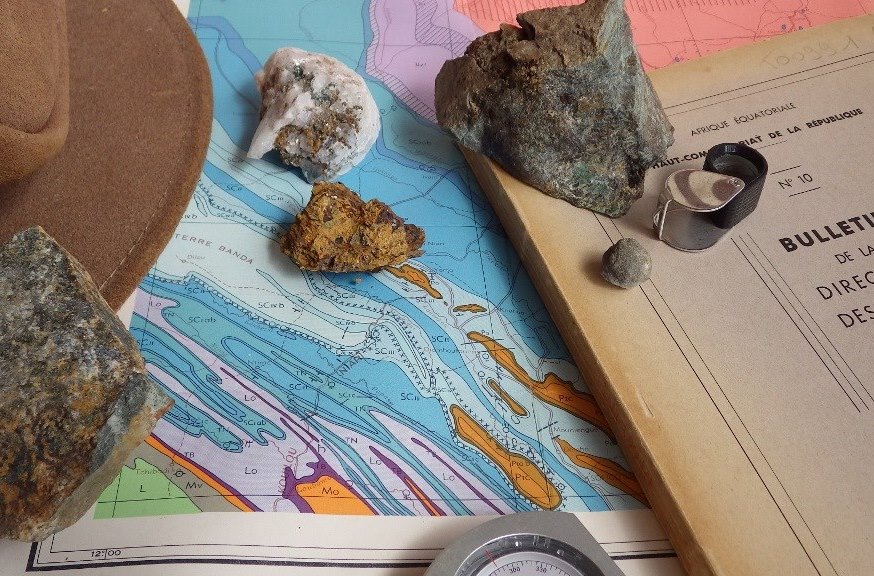
In this section, we will provide an overview of the mining exploration methods and techniques that can be used by amateur mineral prospectors.
My PhD thesis summarised for the rockhounders
In this short section, a young PhD student in geology/mineralogy explains his work in relation to metallogeny and/or mineralogy in simple terms.
Prospecting Echoes
A look back at some of the recent mineralogical discoveries made in the field. Here, we give the floor to prospectors who are willing to share their findings and adventures.
Quartz crystals in the Gabonese Stone Line
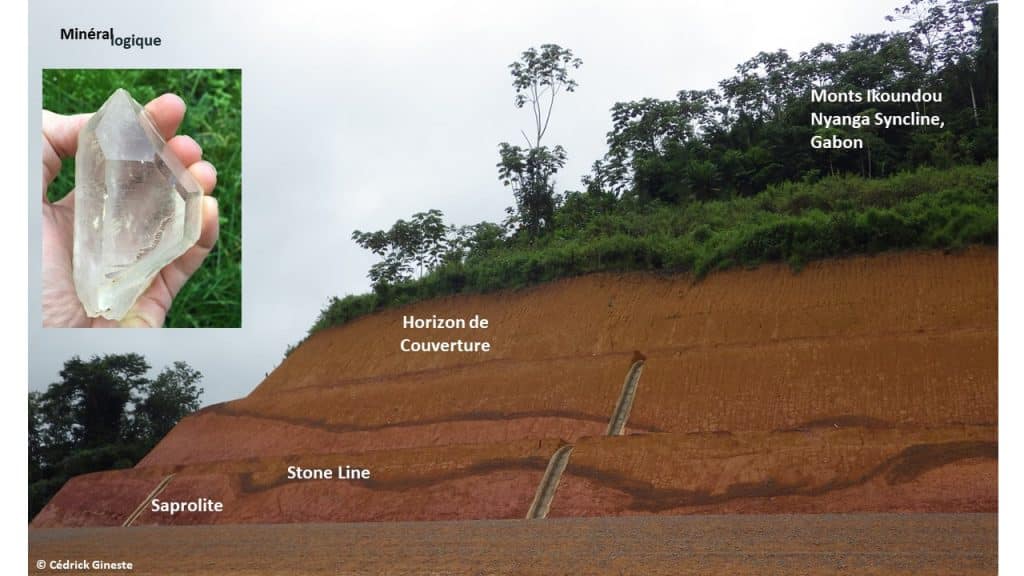
A few years ago, road works between Ndende and Tchibanga uncovered beautiful sections of Gabon’s distinctive weathering profile. We used the opportunity to sample the saprolite in order to obtain valuable geochemical information.
The yellowish layer at the top of the embankment is the Cover Horizon, which is actually wind-blown silt (loess) from southern Africa, deposited around 35,000 years ago. It varies in thickness from 1 to 4 metres and is found almost everywhere in Gabon. It covers much of the bedrock, but is currently being eroded.
Weathering profile on carbonate rocks of the Nyanga syncline, Gabon
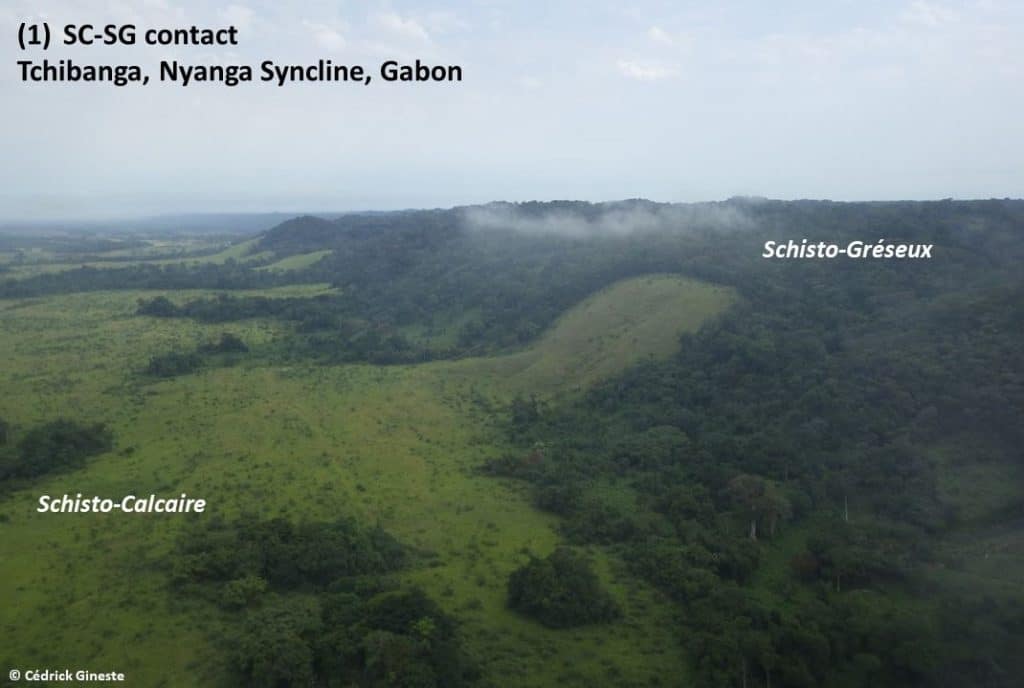
Even without remarkable minerals, I find regolith fascinating. Given the questions raised by my last post, I suggest staying in Gabon and see what the weathering profile looks like a few kilometres away from the Ikoundou Mountains and their hyaline quartz.
Let’s head for the plain of Tchibanga which is characterized by a beautiful savannah clearly visible on satellite imagery. It constitutes the south-western flank of the Nyanga syncline, the heart of it being the Schisto-Greseux group while the flanks are made up of the Schisto-Calcaire group. A particularly good example of the geological control of vegetation.
Landform and regolith in the Tenkoto area (Eastern Senegal)
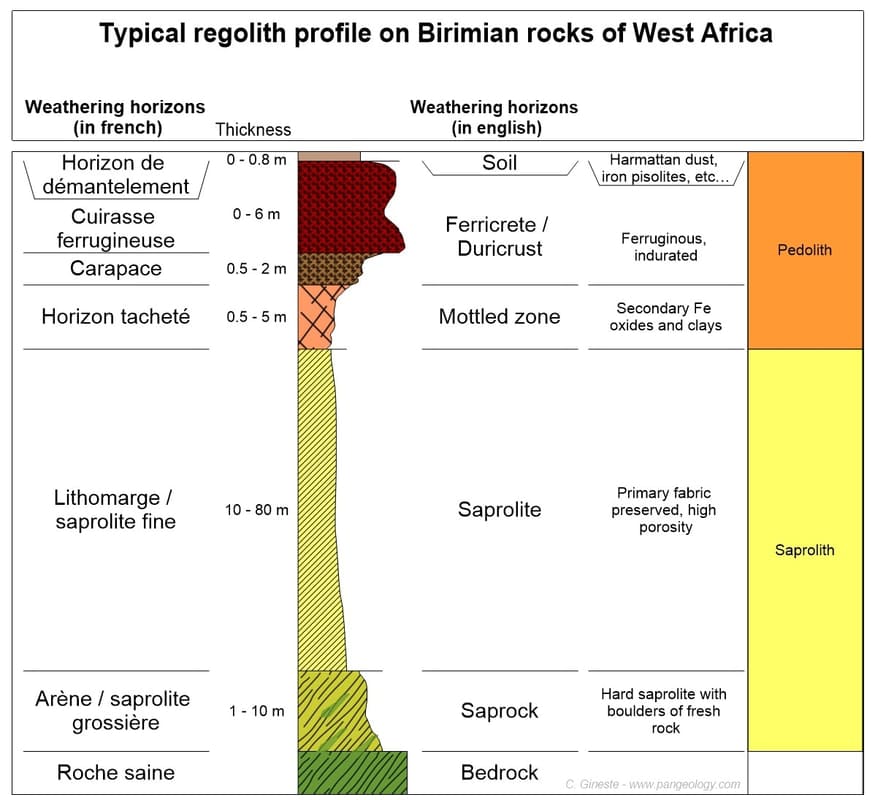
The weathering profile developed on the Birimian rocks of West Africa is, or looks, relatively simple. But its genesis is not. A few years ago, within a research team of IRD, I worked in the Tenkoto area (Senegal), already studied by P. Michel in the 60’s and 70’s and very adapted to examine the filiation of the ferricrete.