Gabon is a country with an equatorial climate and a thick, omnipresent vegetation cover. In this challenging context outcrops are extremely rare and road works are a blessing for the geologist in search of lithological and structural information.
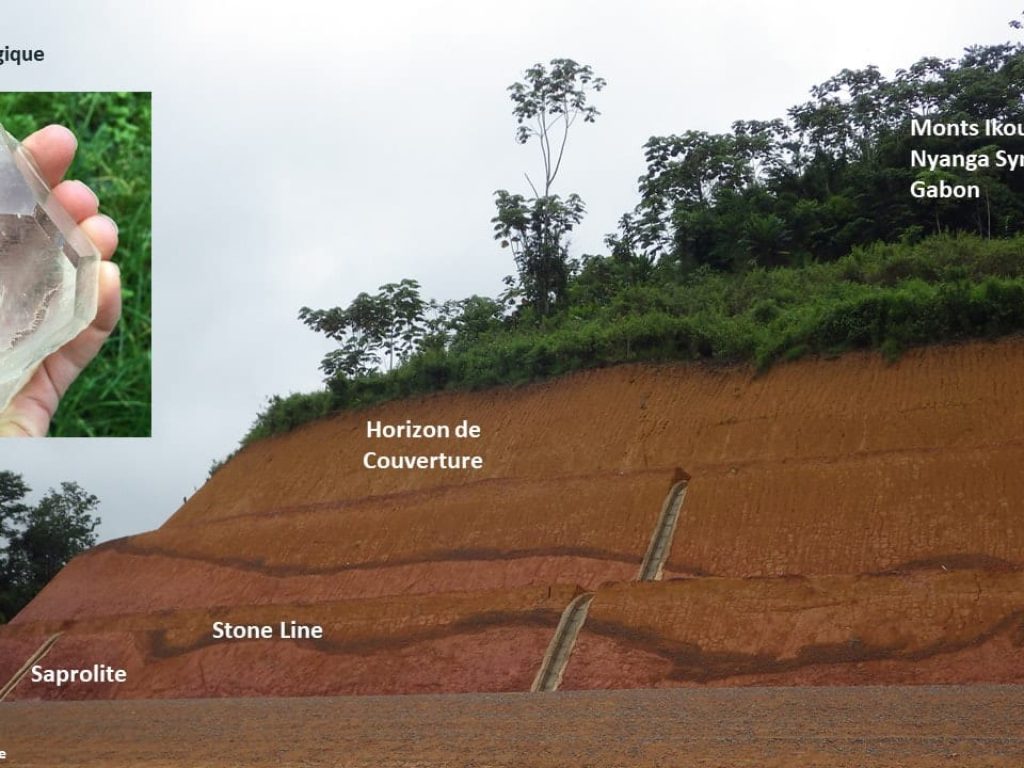
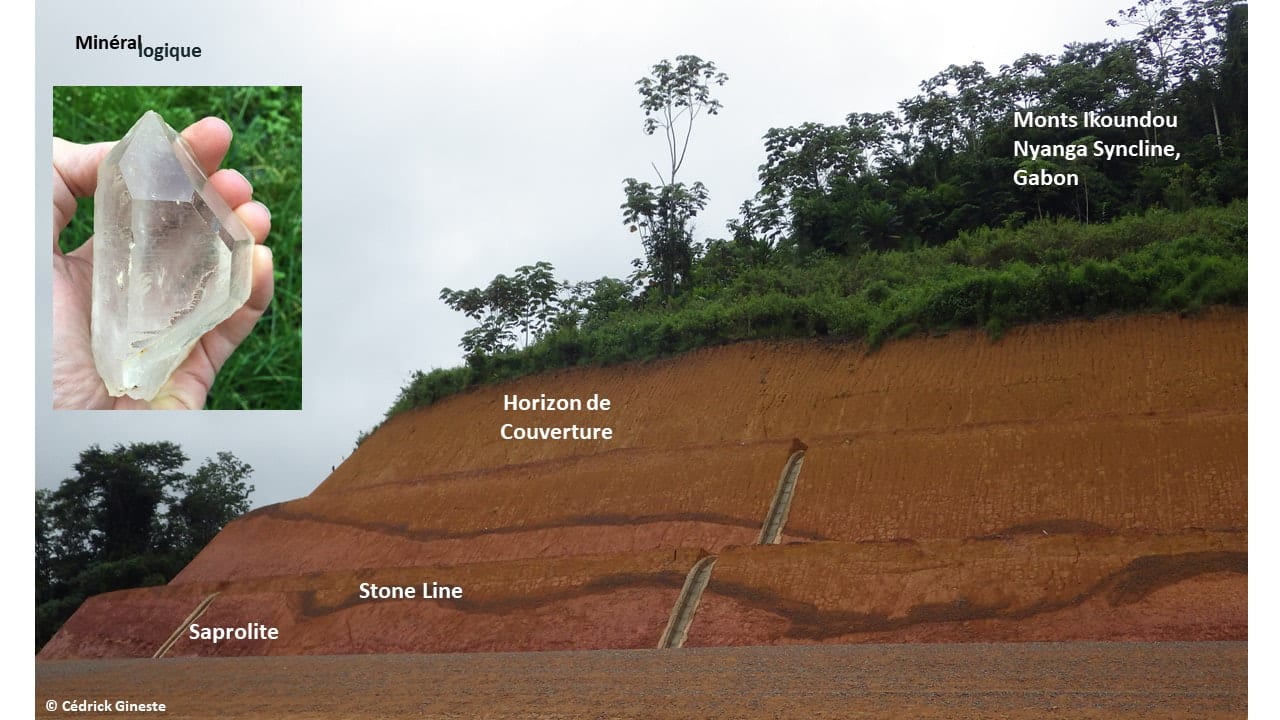
A few years ago, road works between Ndende and Tchibanga uncovered beautiful sections of Gabon’s distinctive weathering profile. We used the opportunity to sample the saprolite in order to obtain valuable geochemical information.
The yellowish layer at the top of the embankment is the Cover Horizon, which is actually wind-blown silt (loess) from southern Africa, deposited around 35,000 years ago. It varies in thickness from 1 to 4 metres and is found almost everywhere in Gabon. It covers much of the bedrock, but is currently being eroded.
In 2016, during the road works, we mapped and sampled the saprolite to obtain geochemical information. At the same time, I noticed the presence of crystals. In the Ikoundou Mountains, located in the heart of the Nyanga Syncline, quartz veins are found in Neoproterozoic sandstones. Several large free crystals were encountered almost intact in the Stone Line, proof that this horizon is transported over only a short distance.